Swimming The Ironman Wales Circuit

Preparing for the Ironman Wales Swim

The Iron Man Wales event that's hosted in Tenby Pembrokeshire every year is widely reckoned to be one of the toughest Ironman events in the world.  Here's a snippet from AI:


One of the hardest and most relentless full-distance courses in the world. It features a chaotic, choppy sea swim, a punishing bike route with nearly 2,500m of elevation gain, and a hilly coastal marathon.

For a realistic breakdown of why this course is so notoriously difficult:

1. The Swim (2.4 miles)

The challenge: Held at North Beach, the swim takes place in the open and sometimes turbulent Irish Sea. It involves a two-loop course with an "Aussie exit" (running out onto the sand before diving back in) and requires navigating choppy waters and swells.

The iconic transition: Once out of the water, athletes face a famous, lung-busting run up a steep, zig-zagging ramp and through the town to get to the transition area.

2. The Bike (112 miles)

The challenge: This is a hilly, two-loop route through the Pembrokeshire countryside. Unlike flat, fast courses, Ironman Wales forces constant effort changes with almost 2,500m of total climbing.

The atmosphere: You will face steep inclines like Saundersfoot and "Heartbreak Hill". While the crowds provide an electric, Tour de France-style atmosphere that pushes athletes up the climbs, the undulating nature of the course means your legs get very little rest.

3. The Run (26.2 miles)

The challenge: The marathon consists of four hilly loops through Tenby and the surrounding coastal terrain, racking up about 500m of total ascent. It is entirely uphill or downhill, meaning you are constantly stressing your quads and calves.

The aftermath: Because of the grueling bike leg, tackling a hilly marathon exposes any nutritional or pacing errors you made earlier in the day.

Course Difficulty Summary

Average Times: Due to the extreme terrain, the median finishing time is usually between 11 and 14 hours.

Cut-Off Times: You have the standard 17-hour cut-off to finish the race, but the high difficulty contributes to a higher-than-average Did Not Finish (DNF) rate, typically hovering around 8% to 12%.

Tackling the Ironman Wales Swim...

For many people the Ironman Wales swim circuit is an extremely tough challenge and one they do simply to get through it and get on to the other disciplines, certainly not because they enjoy it!

However with a bit of preparation and if possible some repeat training sessions doing the actual course with people who know how to swim it, it is possible to turn that challenge into a really enjoyable part of the overall event.

Clockwise or Counter Clockwise?

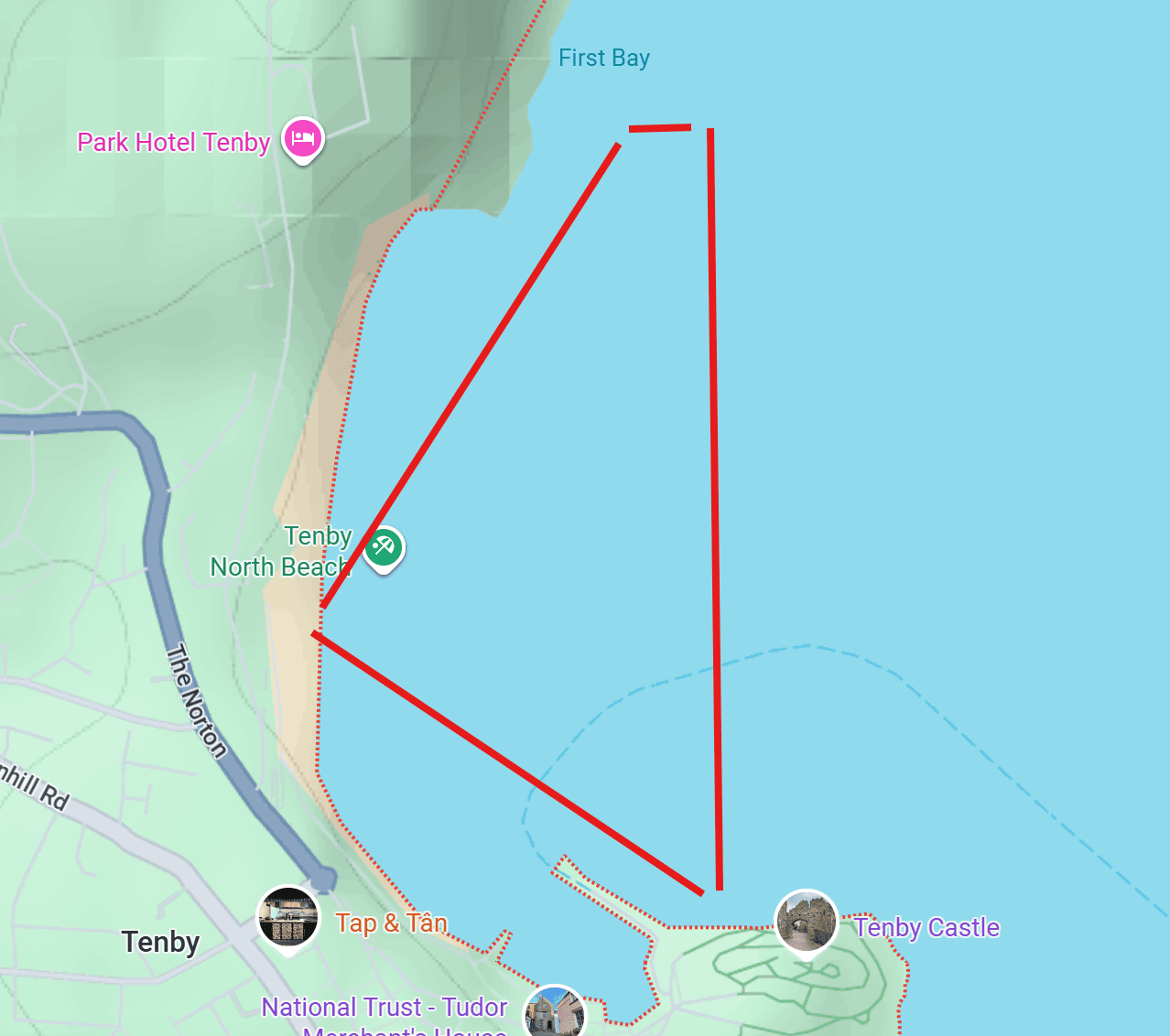
The swim route used to run clockwise, in an inverted triangle, and as mentioned above there was an Aussie style exit where you would have to come out of the water and run around Goscar Rock to do the second lap.

That changed fairly recently and it is now an anticlockwise swim with the buoys on your left side, still in the familiar inverted triangle shape.
Tenby Ironman Wales swim route

Currents

There is a lot of talk about why this change was made but it's generally agreed that it was due to currents that usually flow from east to west when out of the lee of the headland, that is, from right to left when looking out to sea from North beach.

I've heard many people mention problems with currents even with the new direction, but having swum this route thousands of times in my experience the current does tend to flow from right to left, which means the new route is easier as the current will be behind you when you swim along the 'base' of the inverted triangle. This is not meant as a statement of fact, it's just my experience swimming this route many many times, over many years. I think this is probably why the route was changed because I have seen swimmers trying to go the other way (the original route) and swim for 20 minutes without moving along that triangle 'base'.

At any rate, it is important to note currents are only applicable on this route on the 'base' part of the inverted triangle because on the two 'sides' there is no current because you are protected by a large head land with a convenient castle on top, which we will mention later! And actually, sometimes there is no current at all.

The Start

Without a doubt, the start of the swim and the entire event is an incredible experience. The sun rises in the east just as the Welsh national anthem is played and sung along by thousands of spectators who line the cliff tops behind the athletes. This is followed by a good bout of AC/DC along with fireworks and excellent commentary, just to get you extra pumped up before thousands of swimmers enter the water in a rolling start.

For many athletes this is one of the most nerve wracking parts of the swim. There's no other way to describe it: it is utter chaos. 

You really just have to find your 'place' and if the physical nature of swimming with so many people in close proximity is a major problem for you then my advice is to get on the edges away from the centre pack. 

It does really help if you can get into a rhythm by understanding your stroke rate and having some kind of counter 'mantra' as part of your stroke; as well as make use of effective sighting so that you can stay on course, even if everyone else around you is veering off left right and centre!

Sighting

Sighting is often one of the most underrated and under practised parts of open water swimming. There are generally three parts to effective sighting: 

  • How to sight
  • How often to sight
  • What to sight on

Learn more about sighting techniques here.

"What to sight on"
As mentioned in the above description from AI part of the challenge of the Ironman Wales swim is the unpredictable nature of the sea conditions.

In September it can be flat calm or it can be completely mental swell, with five or six feet waves. If you get the latter conditions on the big day there is a strong chance you will not be able to sight on the buoys even though they are brightly coloured and 6 feet high. 

It makes sense to have a backup and sight on permanent land based features that you can see easily and quickly. As a guide you can use the following features that are usually dead centre aligned with the swim buoys:
Leg 1:
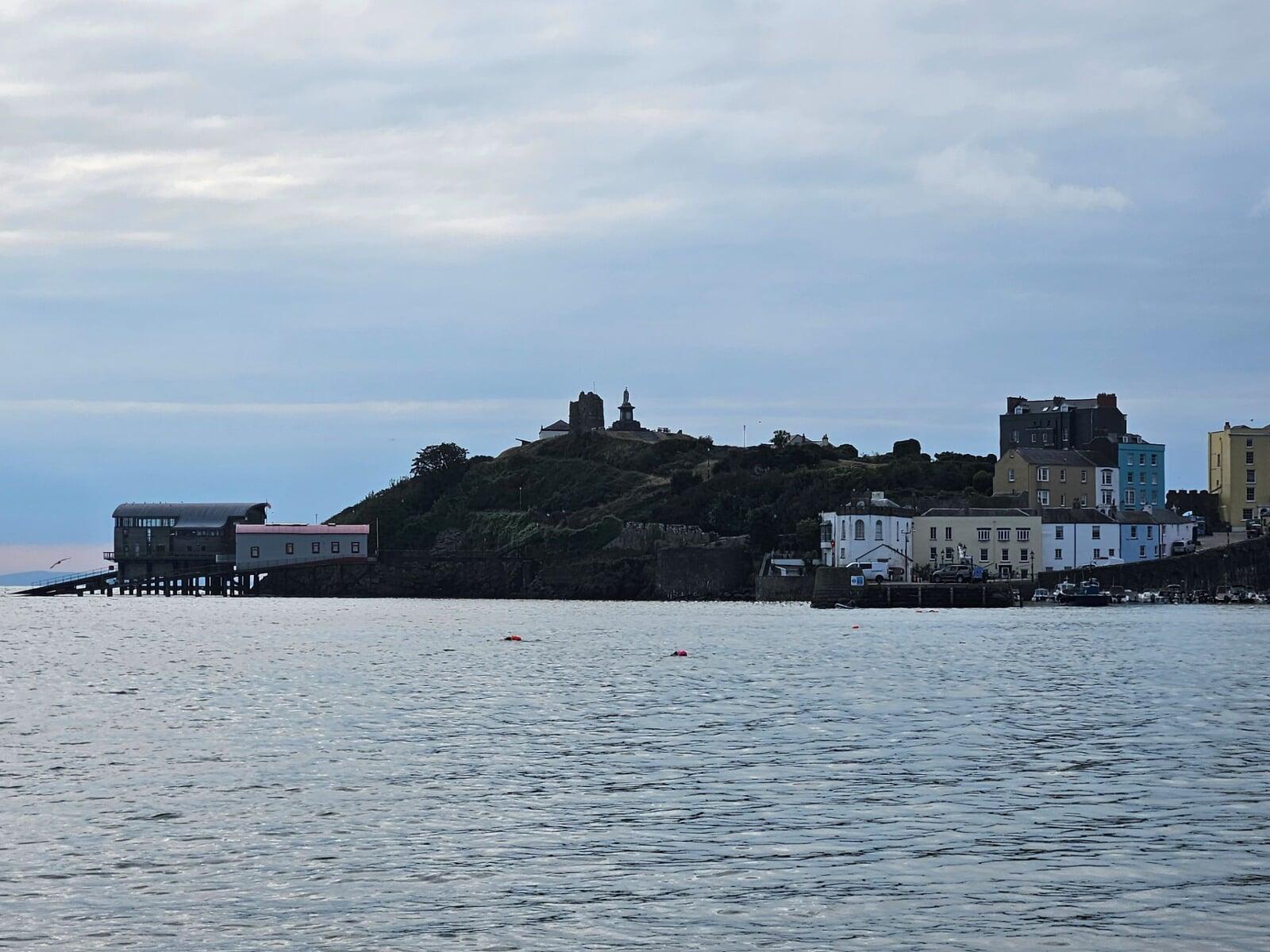
The most obvious sighting feature here as you can see in the image below is the ruined castle on the top of the hill. It is almost directly in line with the first buoy and has the added advantage that it is clearly silhouetted against the pale sky and therefore easier to see, especially when you consider the first leg will be when most people are going to be swimming in front and around you.
Ironman Wales swim route - sighting on leg one
Leg 2:
The shot below was actually taken at low tide and on the day the beach you see in the foreground would all be underwater. This leg is in my opinion the most difficult to sight from because it is very difficult to know exactly where the buoys will be placed until the day before the event. With this in mind, I recommend you go to the location as soon as the buoys are out, walk up to this very spot on the pathway that winds below Tenby castle. From there, take a look and align yourself behind the first buoy looking to the second buoy.

There are a number of features on the skyline you can see that can be used to sight from if you are unable to see the buoy during the swim:

  • the right edge of the wheat field
  • the small copse on the skyline, almost centre of the shot
  • the very obvious drop off the cliff on the right hand side...


Any of these can be used for sighting as it is not necessary to sight on something that is exactly in front of you - you can sight on something that is at 11 o'clock, or 1 o'clock, or 2 o'clock to your position. By checking out the location of the buoys beforehand you will get an idea of what you can site on for leg 2.
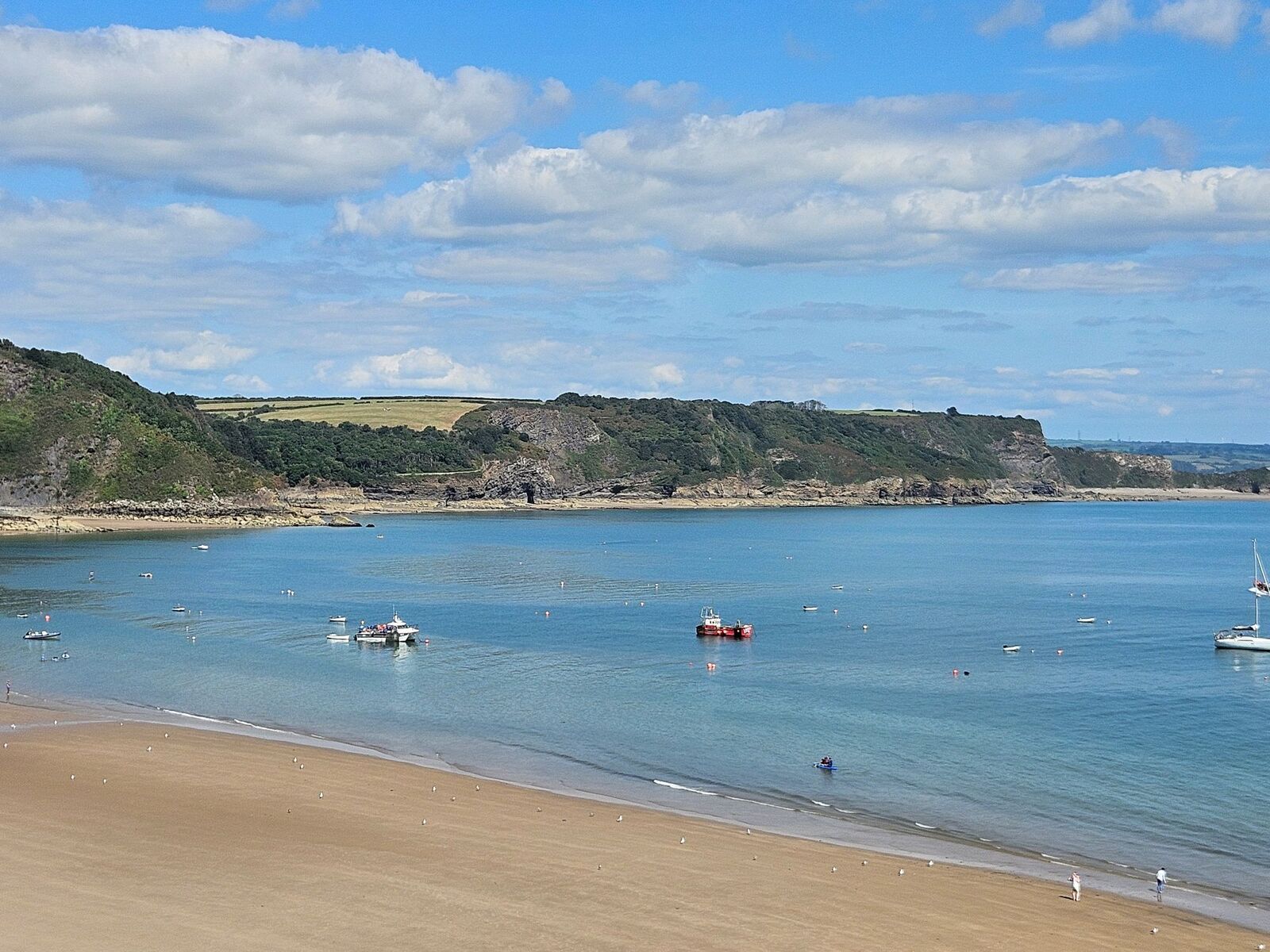
Sighting on the Ironman Wales swim route
The final leg...
After a small stretch between buoy 2 and 3 (see above route map) you are into the home stretch back to the beach. There's a lot of advice flying around on the internet about what to sight from including different coloured buildings or gaps in buildings on the skyline.  

Forget trying to notice building colours on the terraced houses: If you have enough time to register the colours of tightly packed terraced buildings then you are not sighting correctly and your legs are dropping! 

That said, coloured objects can be used if they are 'stand alone' and very easy to see.

Although taken at low tide the image below shows some good examples of what you can (and cannot) use for sighting.

Good...
  • The red cafe to the right of Goscar rock - not perfect but it is separate from terraced houses on the top of the Cliff and fairly easy to see.
  • The white apartment block on the right side - very bright and very easy to see but would not be taken as a "12 o'clock" sighting reference, but rather a 2 o'clock reference point, with you swimming to the 12 o'clock direction.
  • The gap between the elegant terraced houses and the apartment block on the right side - reference points as above.

Not So Good...
  • Goscar rock is the size of a church and although you might think it would make a good sighting object, as you can see in the image below it's actually quite difficult to see as it gets camouflaged with the cliff behind. If you can see it though, use it. 
  • Coloured terraced houses - it is almost certain that you will not be able to sight and have enough time to distinguish different coloured houses. In addition with the nerves of the event you will more than likely forget what coloured house you are sighting on!
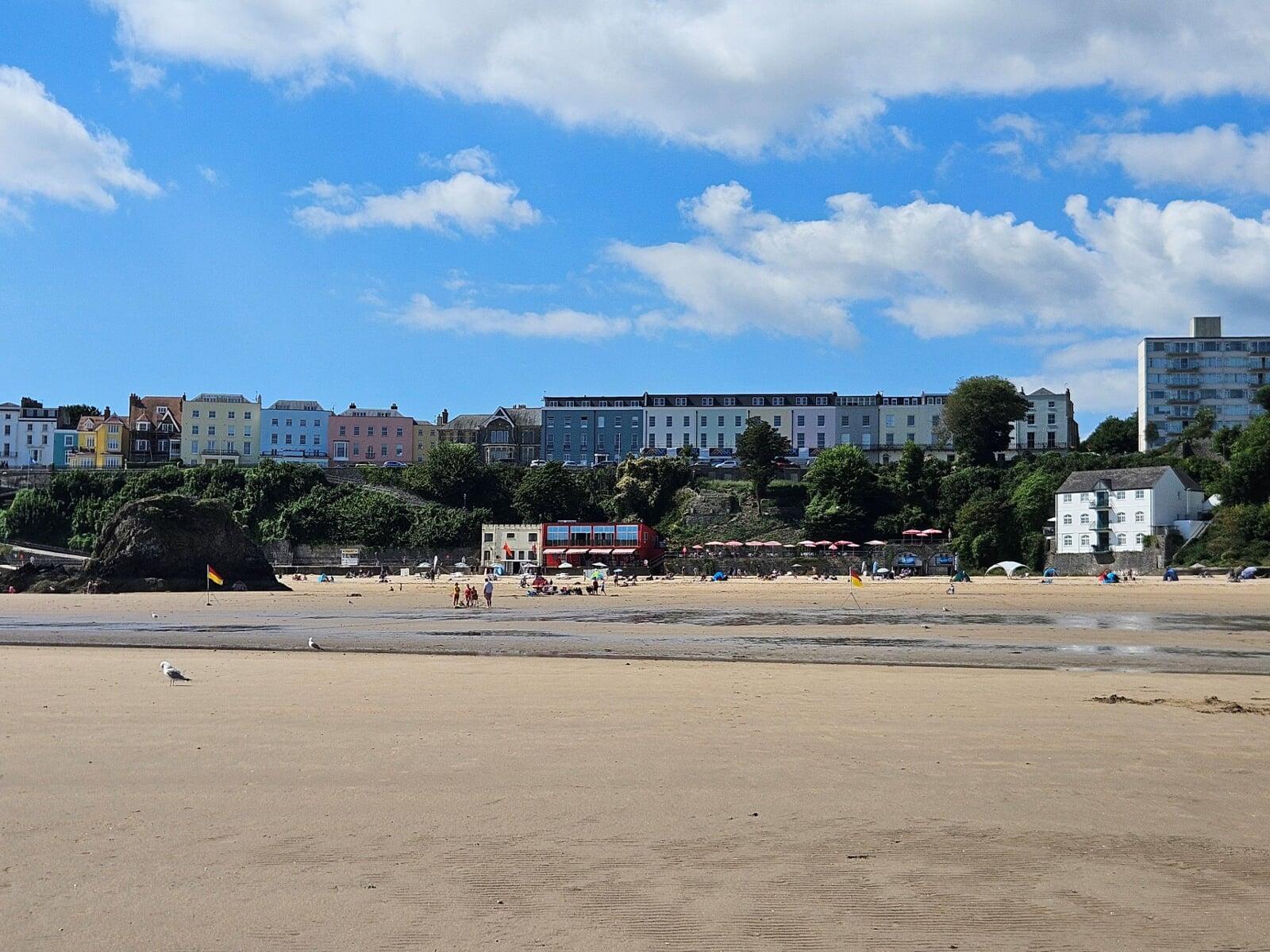
How to sight on the Ironman Wales swim route

The Exits

If the waves are big then it's actually an advantage for you on the third leg of the swim and on the exits. 

Use the energy of the waves and give a little extra kick or pull as a wave comes over you and then you will be able to ride in 1-2 metres without any effort. 

When you exit, swim as shallow as you possibly can. Use the waves an bodysurf right in. I'll typically surf in to a depth of about 30 centimetres if I can. 

Dig your fingers in the sand to get a good grip and then launch yourself out into a full run to get around the rock or out when you exit after swimming full distance.

Conclusion

After many times swimming this route it's easy to say that it's not so difficult, but without sufficient exposure to the conditions or without practising the above kinds of techniques it will be a tough swim, especially when the wind is up and the waves get bigger. 

Never underestimate the sea  - when you get out of the protection of the headland the entire mood and sea conditions can change. It can get pretty scary pretty quickly so the keyword here is "resilience" - build your exposure to adverse sea swimming conditions by getting out there as often as possible preferably on the course that you are going to do. Learn how the sea behaves and what wind directions will result in what sea conditions. If the wind is offshore (blowing from the land out to sea) then you are in for an easy swim. If the wind is blowing onshore (from the sea to the land), then you are in for a ride! 

Try to make sure you go to Tenby a few times if possible, or for a few days, in order to do as many swims around the route as possible so that it feels familiar on the day.

Use Expert Advice 

If you prefer to be accompanied around the Ironman swim route, feel free to book a swim with us and we will show you how it's done and provide useful tips and tricks as well as expert feedback on your stroke.
Good luck!