Swim Smarter, Not Just Harder:
Using Training Aids to Improve Swimming Performance
How resistance, drag, hand paddles and fins can help swimmers develop better technique, greater strength and improved efficiency.
Introduction: Why Making Swimming Harder Can Make You Better
Swimming is a sport where small improvements in technique can make a significant difference to performance.
Whether you're a competitive swimmer, open water enthusiast, triathlete or simply looking to improve your swimming, understanding how your body moves through the water is essential.
Unlike running or cycling, swimming requires us to generate propulsion through water while simultaneously minimising the resistance that slows us down.
This presents an interesting question:
How can deliberately increasing resistance and drag during training actually help us become better swimmers?
The answer lies in understanding how resistance training aids can develop swimming-specific strength, improve body awareness and expose technical weaknesses.
- I believe that technique should always provide the foundation for developing fitness and strength.
- There is little benefit in becoming stronger if that additional power is wasted through inefficient movements.
- Let's explore how some simple training aids can help us swim more effectively.
1. Understanding Resistance and Drag in Swimming
Water is approximately 800 times denser than air, making movement through it particularly demanding.
Every movement creates resistance. Some of that resistance is unavoidable, but much of it can be reduced through improved technique, better body positioning and more effective stroke mechanics.
There are three principal types of drag affecting swimmers:
Form drag: Resistance created by the shape and position of the swimmer's body.
Frictional drag: Resistance generated as water moves across the swimmer's skin, clothing and equipment.
Wave drag: Resistance associated with waves generated as the swimmer moves near the surface.
An efficient swimmer aims to minimise unnecessary drag while maximising useful propulsion.
However, during training, deliberately increasing resistance can be beneficial.
Additional resistance challenges the muscles involved in swimming and can help identify weaknesses in stroke mechanics.
The key is applying the correct amount of resistance without compromising technique.
2. Drag Socks and Fabric Resistance Aids
One of the simplest and most inexpensive methods of increasing resistance is to use fabric around the feet or ankles.
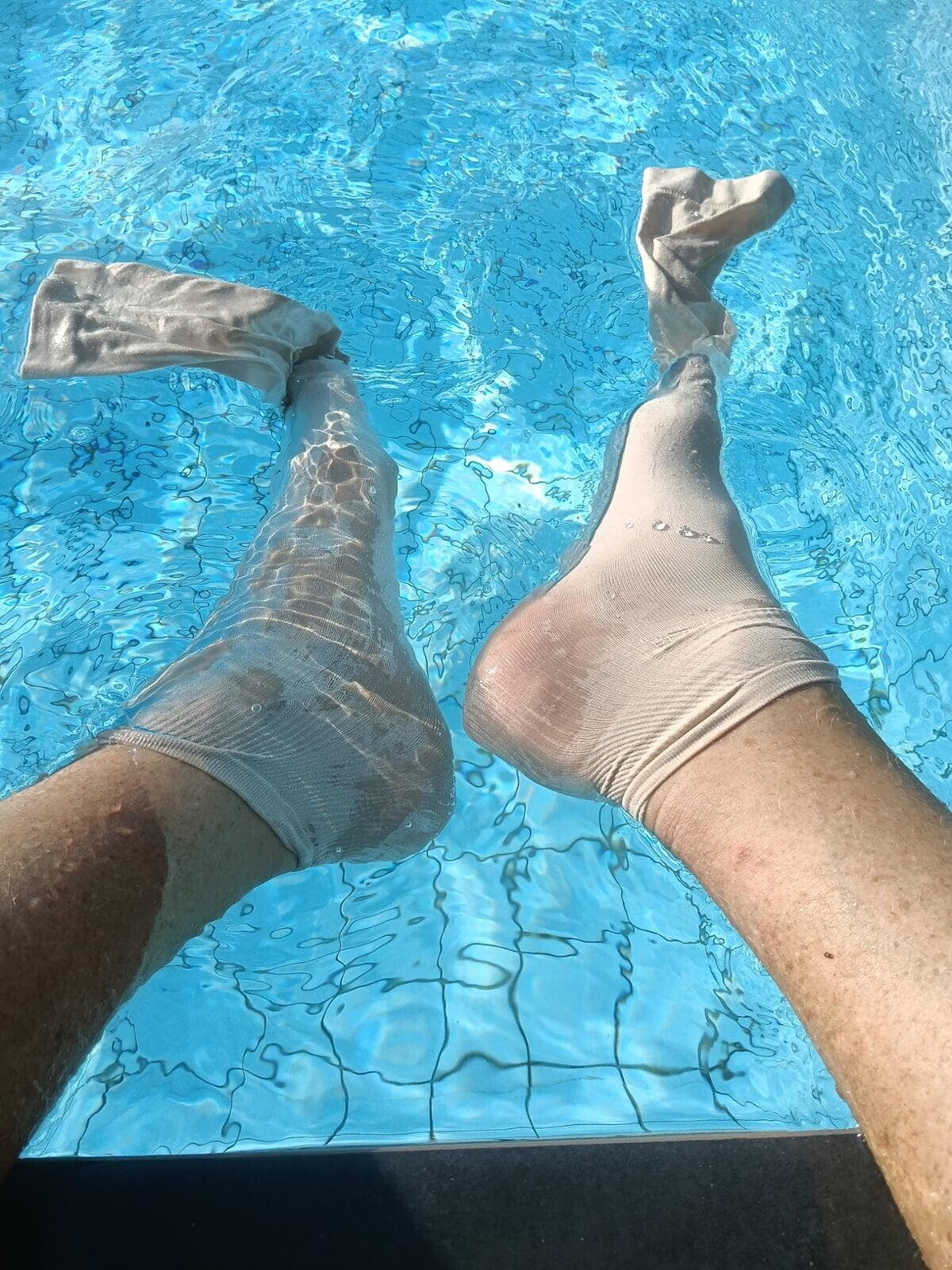
As shown in my photographs, even ordinary fabric sleeves or socks can create considerable drag when moving through water.
Although purpose-made drag socks provide more consistent resistance, simple fabric aids can demonstrate the principle.
What are the benefits?
Swimming with additional drag can:
Increase the effort required to maintain forward momentum.
Develop swimming-specific muscular endurance.
Encourage awareness of body alignment and streamlining.
Challenge the swimmer to maintain an effective catch and pull.
Highlight weaknesses in propulsion and stroke coordination.
For example, a swimmer who struggles to maintain forward momentum when resistance is added may discover that their underwater pull is less effective than they originally believed.
However, added drag does not automatically identify the cause of a problem. It provides a training challenge that must be interpreted alongside the swimmer's technique.
A simple resistance exercise
Try the following:
4 × 25m freestyle with light drag resistance
Maintain a controlled stroke rate and focus on producing effective propulsion.
4 × 25m freestyle without resistance
Remove the resistance and repeat at a similar effort.
Notice the difference in how the water feels and how easily you move forward.
The objective is not simply to swim faster after removing the resistance, but to maintain good technique and an effective stroke.
Coaching note: Loose fabric can become displaced or interfere with kicking. Purpose-made resistance equipment is preferable for regular training.
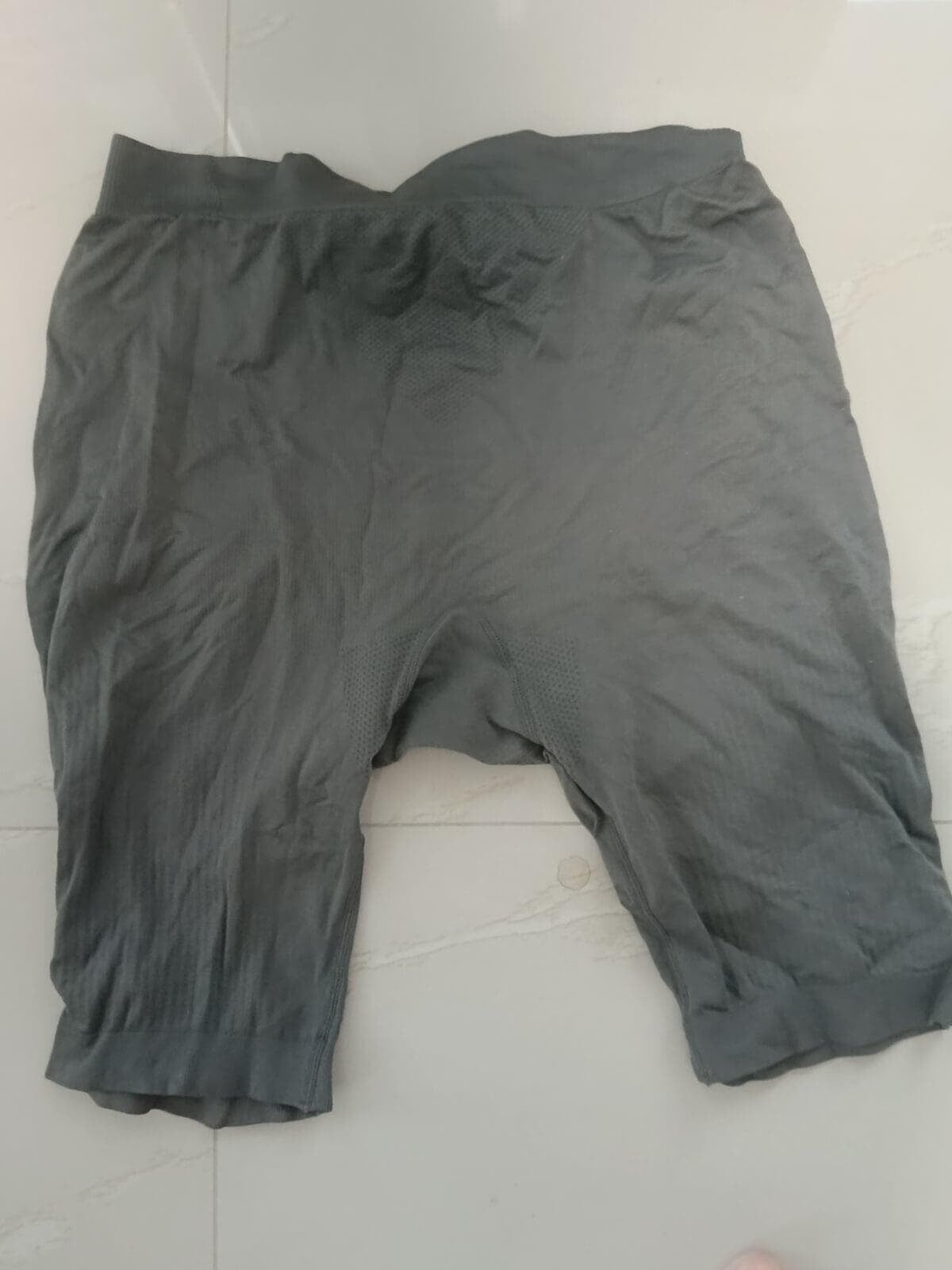
The example below are not meant for swimming but R two do-it-yourself types of swimming aids that I have used in the past from a thick kind of under lagging for hiking or cycling that is perfect for putting under your swim jammers and absorbing a lot more water. (When I was a kid we even swam in ladies tights!)
3. Swim Parachutes and Purpose-Built Drag Devices
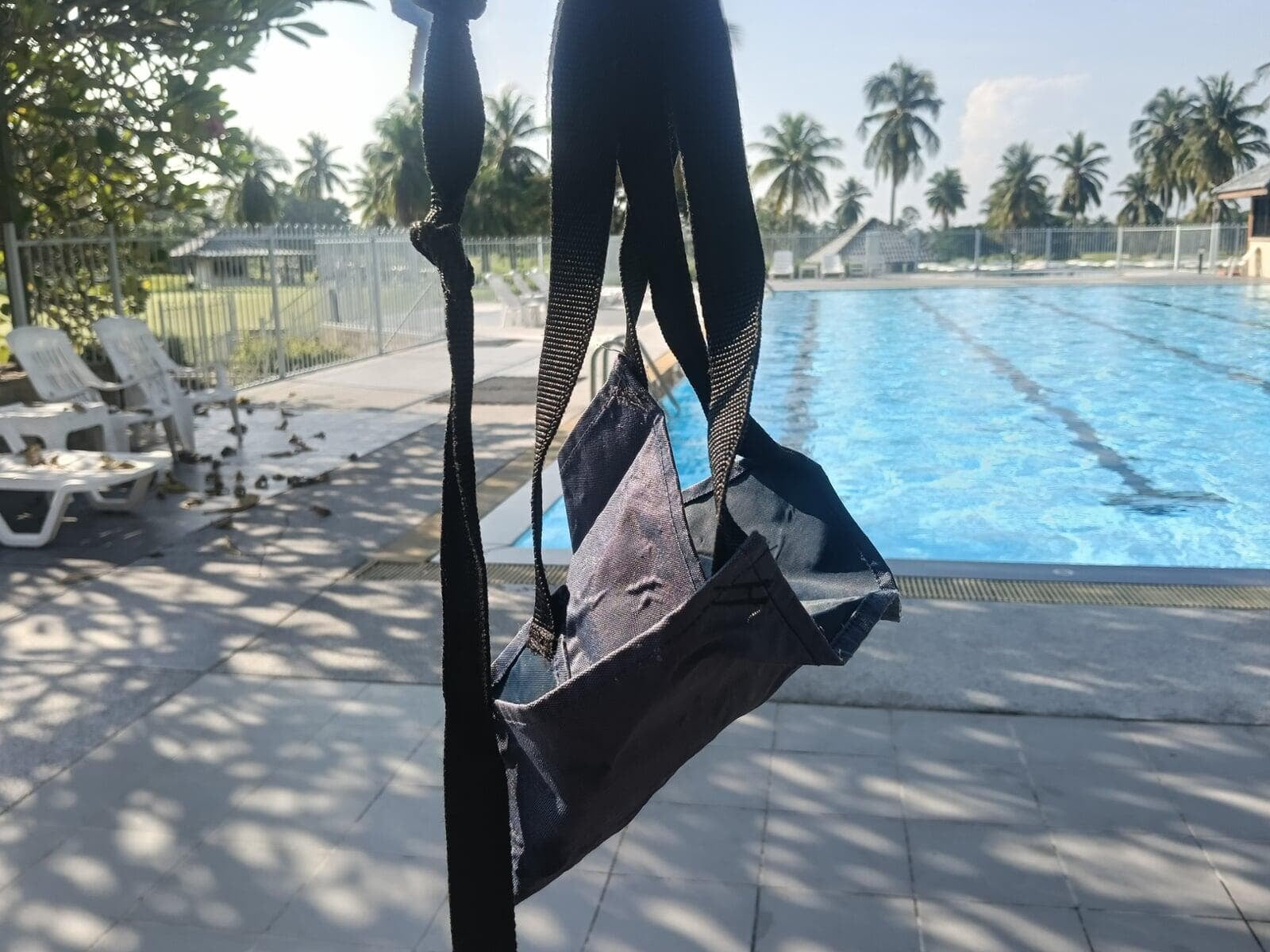
Swimming parachutes are designed to create resistance behind the swimmer.
Unlike hand paddles, which increase the surface area used to generate propulsion, parachutes increase the resistance the swimmer must overcome.
They can be particularly useful for developing swimming-specific strength and maintaining effective stroke mechanics under load.
Benefits of parachute training
Develops strength in the muscles responsible for propulsion.
Challenges the ability to maintain stroke length.
Encourages effective hand and forearm positioning.
Provides an additional training stimulus without requiring high swimming speeds.
Can reveal technical weaknesses that become more pronounced under resistance.
However, resistance should be carefully controlled and swim parachutes are quite difficult to master as they can be quite obtrusive, snagging in legs and so on. Excessive drag may cause swimmers to shorten their strokes, lose body alignment or adopt inefficient pulling patterns.
The objective is to maintain good technique against increased resistance, not simply fight against the water.
4. Hand Paddles: Strength, Propulsion and Feel for the Water
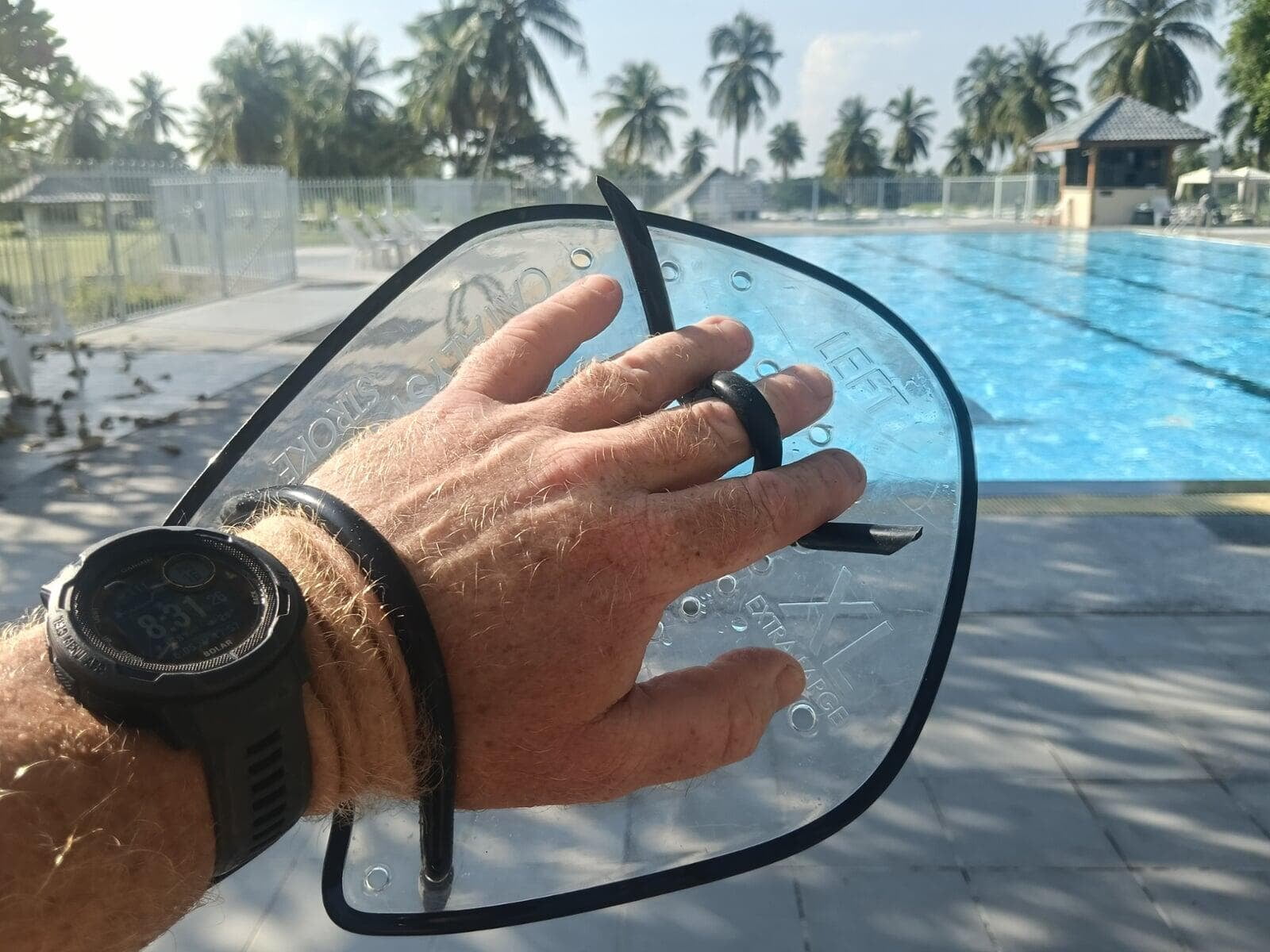
Hand paddles are among the most popular swimming training aids.
They are often associated with developing upper-body strength, but their value extends well beyond muscular conditioning.
Different paddle designs can provide feedback about hand positioning, forearm alignment and the effectiveness of the underwater pull.
Traditional hand paddles
Larger paddles increase the effective surface area of the hand.
This creates greater resistance during the pulling phase and can increase the load placed on the shoulders and upper-body muscles.
When used correctly, they can help develop propulsion and swimming-specific strength.
However, the increased surface area may also compensate for weaknesses in the swimmer's natural catch.
Technique-focused paddles
Some specialist paddles are designed to encourage greater awareness of hand positioning and pressure against the water.
These can help swimmers recognise when their hand is slipping or when the catch is not being established effectively.
What should swimmers focus on?
When using paddles, concentrate on:
Establishing an effective catch.
Maintaining good hand and forearm alignment.
Applying pressure backwards through the water.
Avoiding unnecessary lateral movements.
Maintaining controlled body rotation.
A word of caution
Paddles increase the load on the shoulders.
Using paddles that are too large, particularly with poor technique or limited shoulder mobility, can increase the risk of discomfort and injury.
Start with smaller paddles and controlled distances.
A bigger paddle does not automatically produce a better swimmer.
5. Swim Fins: Improving Body Position and Stroke Coordination
Fins are another extremely useful training aid, particularly when working on body position, kicking technique and stroke coordination.
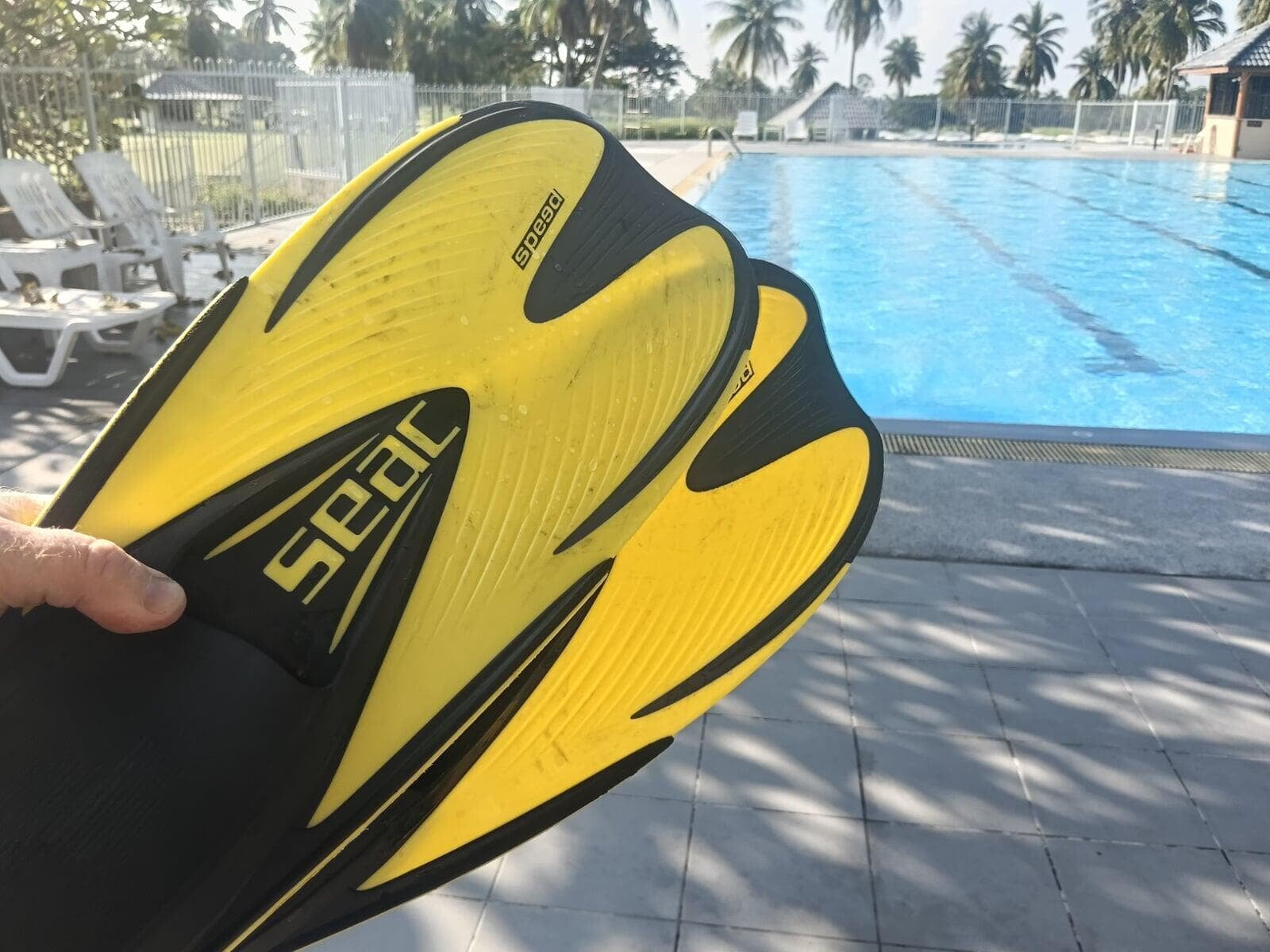
Short training fins, such as those shown in my photographs, provide additional propulsion and can help swimmers maintain a more stable position in the water.
This allows the swimmer to concentrate on other technical aspects of their stroke.
Benefits of training with fins
Fins can help swimmers:
Develop a more consistent horizontal body position.
Improve kicking rhythm and ankle movement.
Focus on body rotation and balance.
Practise breathing without losing forward momentum.
Concentrate on hand entry and arm recovery.
Perform technical drills with greater control.
For example, a swimmer struggling with breathing coordination may find that fins provide enough additional propulsion to practise the movement without becoming excessively fatigued.
However, fins should not become a permanent solution to poor body position.
The objective is to develop the correct movement patterns and eventually reproduce them without assistance.
The Finns in the image below are the ones I use for training and they are standard snorkel size fins, rather than the small pool fins, because I prefer the additional resistance and work out that it gives your core and upper legs. Start with smaller sizes and move up as you progress.
6. Combining Training Aids for Better Results
Different training aids create different challenges.
Drag socks and parachutes increase resistance.
Hand paddles change the forces acting on the hands and arms.
Fins provide additional propulsion and can help stabilise body position.
By combining these tools within a structured training programme, swimmers can develop strength while improving their understanding of stroke mechanics.
The important point is that each training aid should have a specific purpose.
We should not use equipment simply because it makes a training session feel harder.
Instead, ask:
What aspect of my swimming am I trying to improve?
If the answer is body alignment, fins may be appropriate.
If the objective is to develop propulsion under load, controlled resistance training may be useful.
If the swimmer needs to develop awareness of the catch, appropriately selected paddles may provide valuable feedback.
Good coaching involves selecting the right tool for the right technical objective.
7. A Practical Training Session Using Resistance Aids
Here is an example of how different training aids can be incorporated into a structured freestyle session.
Warm-up – 400m
200m easy freestyle followed by 4 × 50m technical drills.
Resistance training – 4 × 25m
Use light drag resistance, concentrating on maintaining stroke length and effective propulsion.
Paddle technique – 4 × 50m
Focus on hand entry, the catch and maintaining pressure through the underwater pull.
Fin-assisted technique – 4 × 50m
Concentrate on body rotation, breathing coordination and maintaining a streamlined position.
Unassisted swimming – 4 × 50m
Remove all training aids and focus on reproducing the technical movements developed during the previous sets.
Controlled swimming – 4 × 50m
Maintain a consistent pace while monitoring stroke count, stroke rate and perceived effort.
Cool-down – 200m
Easy freestyle with an emphasis on relaxed, efficient movement.
Total distance: 1,500 metres
This is an example session for a competent swimmer. Distances, equipment and resistance should be adapted to individual ability and training objectives.
8. How Do We Know If Training Aids Are Helping?
One of the most important considerations when using training aids is evaluating whether they are producing meaningful improvements.
Swimming faster does not necessarily mean swimming more efficiently.
A swimmer may improve their time simply by increasing effort.
To assess improvements, consider several measurements:
Swim time: How long does it take to complete a given distance?
Stroke count: How many strokes are required to cover that distance?
Stroke rate: How frequently are strokes being completed?
Pace consistency: Can the swimmer maintain speed over repeated distances?
Perceived effort: Does the swimmer feel more comfortable at the same pace?
For example, maintaining the same pace with fewer strokes and similar or lower perceived effort may suggest improved efficiency.
However, fewer strokes are not always better. Excessive gliding can reduce momentum and compromise performance.
The objective is to develop an effective balance between stroke length, stroke rate and propulsion.
9. Technique Must Always Come First
There is a temptation in swimming to focus on becoming stronger and fitter before addressing technical weaknesses.
But this approach can be counterproductive.
If a swimmer has an inefficient catch, poor body alignment or excessive drag, increasing strength may simply allow them to swim inefficiently with greater force.
Training aids should therefore support technical development rather than replace it.
The most effective progression is to establish good technique, introduce controlled resistance and then develop the fitness required to maintain that technique over longer distances.
Resistance training can be extremely valuable, but it should never encourage the swimmer to sacrifice stroke quality simply to complete a harder session.
Conclusion: The Right Tools for the Right Purpose
Training aids can make a significant contribution to swimming development.
Drag socks and parachutes provide additional resistance.
Hand paddles help develop propulsion and awareness of the catch.
Fins assist with body position, kicking technique and stroke coordination.
But the real benefit comes from understanding why each piece of equipment is being used.
At Swim Pembrokeshire, my coaching philosophy remains straightforward:
Learn to Swim → Swim to Train → Train to Win.
First, develop an efficient swimming technique.
Then build the strength and fitness required to maintain that technique.
Finally, apply those skills to achieve your swimming goals.
Whether you're preparing for a competitive event, an open water challenge or simply want to become a more confident swimmer, remember:
Swim smarter, not just harder.
Improve Your Swimming Technique with Swim Pembrokeshire
At Swim Pembrokeshire, we help swimmers develop better technique, greater efficiency and improved performance through structured coaching and individual stroke assessments.
Visit www.swimpembrokeshire.com to learn more about our swimming coaching and improvement programmes.