Swimming Technique Versus Fitness
Which came first, the chicken or the egg?
I have been getting into some debates recently with adult students, whose goal is to take their swimming to a new level in order to compete at masters triathlon, IronMan and various open water swimming events. The topic: the age old, fundamental question of "which comes first, swimming technique or fitness?"
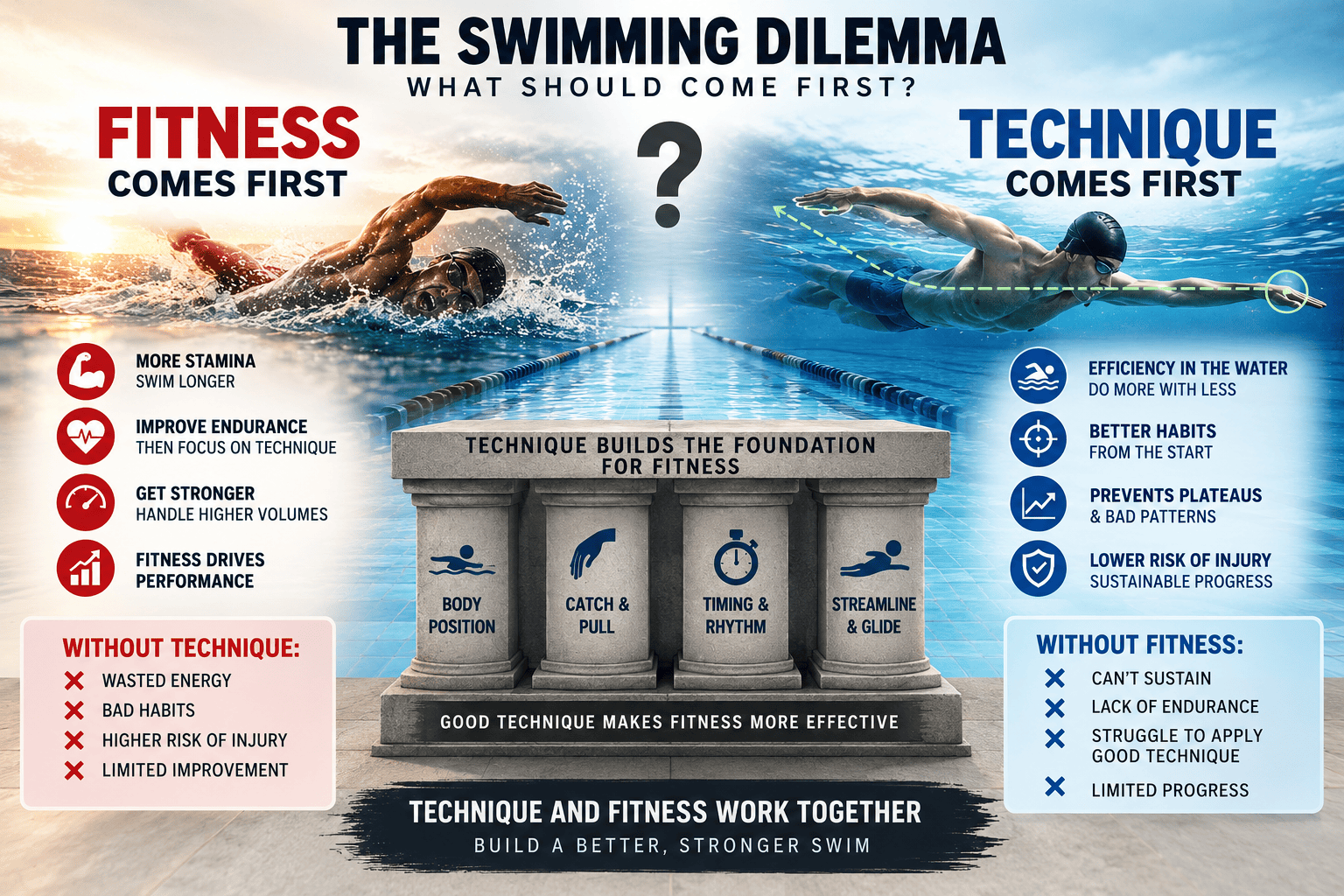
Technique or Fitness: Which Should Come First in Swimming?
It is in fact one of the great debates in swimming:
Should you build your fitness first and let technique develop along the way — or should technique come first, with fitness built on top of it?
It is easy to argue both sides.
Swimming is physically demanding. The fitter you become, the longer and harder you can swim. Cardiovascular fitness, muscular endurance and strength are all important if you want to improve performance.
But there is a problem with developing fitness without first establishing good technique: You can become very fit at swimming badly!
And once poor movement patterns become established, the fitter you become, the more efficiently you can repeat them — but unfortunately, that doesn't necessarily make you a better swimmer.
Fitness makes you capable. Technique makes you efficient.
Imagine two swimmers swimming the same distance.
One has excellent fitness but an inefficient stroke. They work hard, create plenty of effort and maintain a high heart rate, but a significant amount of that energy is lost through unnecessary movement, poor body position and excessive resistance.
The other swimmer may initially be less fit, but has a technically efficient stroke. They maintain a better body position, create less drag, apply force more effectively and waste less energy.
As the distance increases, the difference becomes increasingly obvious.
The technically better swimmer has something extremely valuable:
Efficiency.
And as water is 800 times as dense as air, every single minute movement in the water matters. Efficiency is one of the foundations of endurance swimming.
This doesn't mean fitness is unimportant. Quite the opposite.
Fitness is what allows a swimmer to sustain good technique for longer and at higher intensities.
But that creates an important distinction:
Fitness should support technique — not compensate for poor technique.
The danger of becoming fitter at the wrong stroke
One of the challenges coaches face is that fitness can improve relatively quickly.
A swimmer can increase their training volume, swim more frequently and push harder. Their cardiovascular system adapts, their muscles become stronger and their tolerance for effort improves.
The numbers on the stopwatch may even improve... But underneath that improvement, inefficient movement patterns can become increasingly ingrained.
A swimmer might develop a habit of crossing the centre line, dropping their elbow, kicking excessively, lifting their head to breathe or creating unnecessary tension through the shoulders.
If those movements are repeated thousands of times, they become familiar. And familiar movement is not necessarily good movement.
Repetition doesn't automatically create perfection. It creates permanence. That is why technique deserves attention before simply adding more volume or intensity.
Kids versus adults
Kids are generally much easier to coach. They tend to do what the coach asks, without any question and they are also very adaptable, absorb information easily and are very flexible. This means they can make changes to their stroke relatively easily.
Adults are different. They have often forged their own ideas through adulthood, which can become 'stuck' in their psychology, how they think things should be done.
Also, adults pay money for coaching and want to see results! Going back to basics and taking months to unlearn what they have learned over many years, to correct the swim stroke, can be frustrating for them and the temptation to quit one coach and move on to someone else can exacerbate the problem because they never get to grips with the foundational technique.
Technique is the foundation
Think about building a house...
You wouldn't start by adding extra floors because you wanted a bigger building. You would start with the foundations.
Swimming is no different.
Technique provides the foundation. It establishes the movement patterns that allow a swimmer to:
- Reduce unnecessary drag
- Improve body position
- Apply force more effectively
- Coordinate breathing and movement
- Reduce wasted energy
- Swim more economically
- Maintain form as fatigue develops
Once that foundation is established, fitness becomes much more useful. The swimmer can then train the body to perform that movement repeatedly, under increasing levels of stress and fatigue.
Good technique + fitness creates sustainable performance.
But technique doesn't mean swimming slowly
There is sometimes a misconception that technique work means endlessly swimming easy lengths while concentrating on drills.
It doesn't.
Technique should ultimately exist within the stroke itself.
A technically sound swimmer needs to be able to maintain good movement while swimming slowly, moderately and at high intensity.
This is where fitness becomes important. As fatigue increases, technique is challenged.
The purpose of training is not simply to become fitter. It is to become fitter without allowing the quality of the stroke to deteriorate.
That is a very different objective.
Learn to Swim → Swim to Train → Train to Win
These aren't simply three stages of swimming development. They represent a logical progression.
Learn to Swim
First, establish the fundamentals.
Learn how the body should move through the water. Develop balance, body position, breathing, coordination and the fundamental mechanics of each stroke.
This is where technique is established.
Swim to Train
Once the fundamentals are in place, swimming becomes the vehicle through which fitness is developed. Distance, intensity, endurance, strength and speed can all be progressively trained. But the technique remains the reference point.
The question isn't simply:
"How much can I swim?"
It becomes:
"How much can I swim while maintaining an efficient stroke?"
Train to Achieve a Goal
At the highest level, technique and fitness come together.
The swimmer has the physical capacity to produce speed and the technical ability to convert that capacity into forward movement efficiently.
Training becomes increasingly specific. Intensity increases. Race pace is developed. Fatigue is deliberately introduced.
But even at this stage, everything comes back to the foundation.
The better the foundation, the more you can build upon it.
So, which comes first?
Perhaps the answer isn't that technique and fitness are competing priorities.
They are both essential.
The real question is which one provides the foundation for the other?
Fitness allows you to swim harder.
Technique allows you to swim better.
Fitness helps you sustain the stroke.
Technique determines how efficiently that effort is converted into forward movement in the water.
And when fatigue arrives — whether in a pool session, in the middle a 10K open-water swim, or the final few metres of a race — it is the quality of your technique that determines how much of your fitness you can actually use.
That is why technique should be treated as the foundation of every stroke.
> Learn to swim with good technique.
> Swim to develop fitness.
> Train to turn technique and fitness into performance.
Learn to Swim → Swim to Train → Train to Achieve a Goal.
Before you can train a swimmer to go further, faster or harder, you first need to give them something worth training.